Knee mechanics
The Q-Angle and Your Knee
The knee does not work alone. The position and movement of the hip, femur, foot and pelvis influence the direction in which the kneecap tracks and how load passes through the joint.
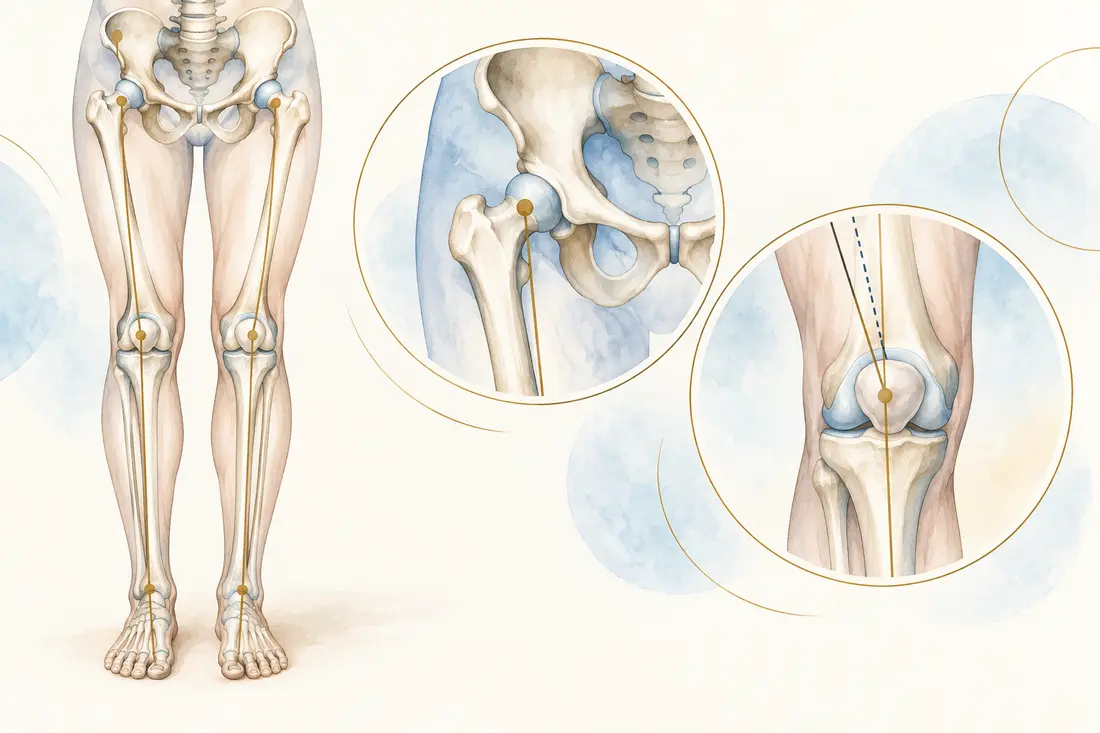
What is the Q-angle?
The quadriceps angle, commonly called the Q-angle, describes the relationship between the line of pull of the quadriceps muscle and the patellar tendon. It helps illustrate how forces from the hip and thigh meet the knee.
The measurement is only one part of the picture. Static alignment matters, but movement matters too. The femur may rotate inward or outward, the pelvis may shift, and the foot may change how the leg accepts load.
Normal and altered knee mechanics
With coordinated movement, the hip controls the femur, the kneecap tracks through its groove and the foot helps absorb and transfer force. When hip control, foot mechanics or joint motion changes, stress may become concentrated along different portions of the knee.
Hip and femoral position influence the Q-angle and knee tracking. This is why an examination of knee pain should often include the hip, pelvis, ankle and foot rather than focusing only on the painful spot.
Why repeated loading matters
A small mechanical change repeated over thousands of steps can be more important than a large change that occurs once. Altered loading may irritate the tissues around the kneecap, place additional demand on the meniscus or change how cartilage surfaces share force.
These mechanics do not prove that damage will occur. They help explain why symptoms can persist and why improving movement may be part of a useful plan.
A broader assessment
Useful assessment may include hip strength and control, pelvic position, femoral rotation, knee tracking, ankle motion, foot stability and the way the patient walks, squats or performs the activity that causes symptoms.
Chiropractic care may address restricted joint motion within this system while exercise and activity changes help improve control and capacity.
This article provides general educational information and does not replace an individual clinical examination, diagnosis or treatment recommendation.